
Hitting a kerb: tyre, wheel and alignment to check
By AZ Carrosserie · Published on
After hitting a kerb, check three things: the tyre (a bulge or a crack means it is replaced), the wheel (a mark can signal a tyre damaged on the inside) and the alignment (a car that pulls, a steering wheel that does not return). In Geneva, AZ Carrosserie examines tyres and wheels in the same workshop.
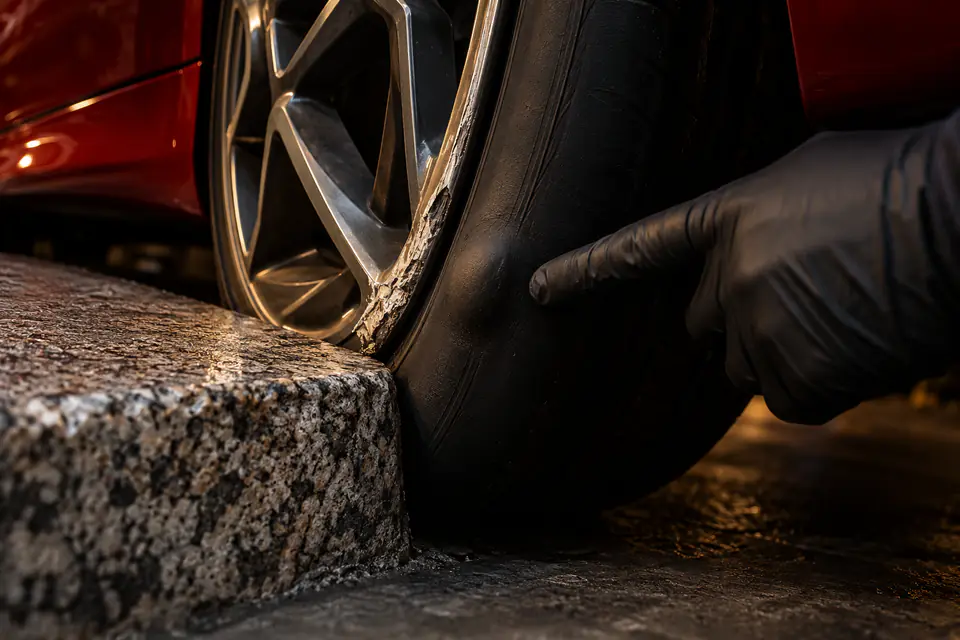
Why does a kerb impact call for a check?
Because the damage is not always visible. When the tyre gets trapped between the kerb and the wheel, it can be damaged without anything showing on the outside, and give way several months later in a blowout. Source: TCS, summer tyre advice brochure, 2025, in French, read on 19.10.2026.
A wheel that still runs normally afterwards is therefore no proof. The safest course is to look at the affected wheel as soon as the car is parked, then have it examined.
What should you look at on the tyre?
Walk around the affected tyre, sidewall included, turning the steering wheel to see the inner part. The TCS lists several marks that can betray internal damage after hitting a kerb. Source: TCS, summer tyre advice brochure, 2025, in French, read on 19.10.2026.
- nicks or cuts;
- discolouration on the tread or on the sidewalls;
- a bulge or a crack, in which case the tyre is replaced without delay.
Do not decide on your own. According to the same brochure, only a professional can say whether a damaged tyre can be repaired or must be changed, and a puncture repair spray only serves to reach the garage; it is not a repair. Source: TCS, summer tyre advice brochure, 2025, in French, read on 19.10.2026.
Take the opportunity to read the tread: the legal minimum is 1.6 mm, and the TCS recommends at least 3 mm in summer and 4 mm in winter. If the change of season is approaching, our article Winter tyres in Geneva: when to make the switch? helps you choose the moment. Source: TCS, summer tyre advice brochure, 2025, in French, read on 19.10.2026.
The wheel is marked: what does that tell you?
A scuffed wheel is not only about looks. For the TCS, traces of rust or damage on the wheel are among the clues that can signal a tyre damaged on the inside, after hitting a kerb. Source: TCS, summer tyre advice brochure, 2025, in French, read on 19.10.2026.
In other words, a marked wheel is a reason to look closely at the tyre. Photograph the wheel and the tyre sidewall with your mobile before driving any further: these pictures help describe the impact. Wheel repair is one of the workshop’s services; what is possible on yours is decided by seeing the wheel.
When should you have the alignment set?
Wheel alignment is the setting of toe, camber and caster. The TCS advises having it set after driving fast over kerbs or over large potholes. Source: TCS Solothurn section, wheel alignment check and adjustment page, in German, read on 19.10.2026.
Two signs should alert you at the wheel:
- the car pulls to one side on a straight road;
- the steering wheel does not return to straight on its own after a bend.
Source: TCS Solothurn section, wheel alignment check and adjustment page, in German, read on 19.10.2026.
The third sign shows on the tyres: uneven wear. Poorly set alignment wears tyres unevenly, and when they wear that way, the axle settings must be checked. Source: TCS, summer tyre advice brochure, 2025, in French, read on 19.10.2026.
How do you avoid the next impact?
When parking. The TCS advises mounting a kerb slowly and at a right angle, so as not to trap the tyre against the edge. Source: TCS, summer tyre advice brochure, 2025, in French, read on 19.10.2026.
The right pressure matters too: an under-inflated tyre gets damaged and bursts more easily. The TCS recommends checking it regularly, with the tyres cold. Source: TCS, summer tyre advice brochure, 2025, in French, read on 19.10.2026.
Who should you show the car to in Geneva?
The workshop that already looks after the tyres. At AZ Carrosserie, tyres are changed when the sidewall is cut: fitting, balancing and a pressure check, detailed on the Tyres and brakes page. Bodywork, tyres and braking, broken glass: everything is handled by the same workshop, one call, one file.
For the alignment, ask the question by phone, describing what you feel at the wheel. The quote form is reserved for bodywork damage: for a tyre, call 076 429 04 12 or write from the Contact page.
Where is the workshop?
The workshop welcomes you at Avenue Pictet-de-Rochemont 33ter, 1207 Genève, in Eaux-Vives. Open Monday to Friday, 7.30 am – 12 noon and 1 pm – 5.30 pm. 34 Google reviews, 5.0 out of 5 as of 19.10.2026: the workshop’s Google listing.
See also: Tyres and brakes in Geneva, the workshop’s service.